
Fragrance Elixirs vs. Fragrance Oils: Understanding Projection, Sillage, and Longevity
Editorial notice: This Journal article is independent educational content. This page currently contains no affiliate links and no paid placement. Product information should be checked against the cited sources and current product label.
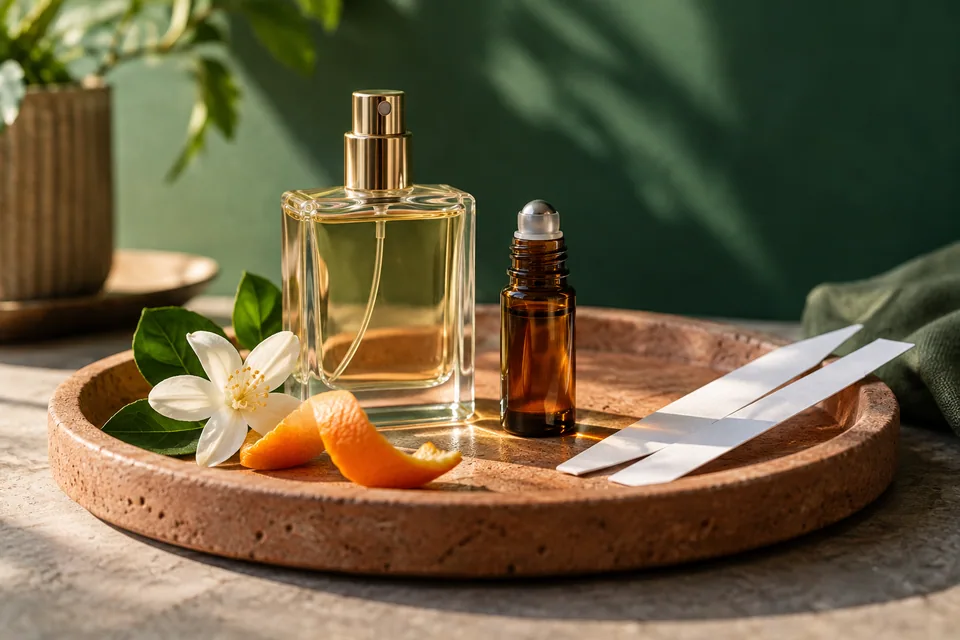
Have you ever bought a highly praised luxury perfume, only to find that it vanishes after two hours? Or applied a rich perfume oil expecting a dramatic entrance, only to realize no one in the room could smell it unless they hugged you? The difference often comes down to one crucial factor: the carrier medium and its relationship to projection.
The Three Pillars of Fragrance Performance
Before comparing Elixirs and Oils, let's decode the three essential terms perfumers use to describe how a fragrance behaves in the real world:
- Projection: How far a fragrance pushes outward from your skin into the room around you (e.g., arm's length vs. across a dinner table).
- Sillage (pronounced see-yazh): The invisible scent trail left behind in the air as you walk through a room or hallway.
- Longevity: The total number of hours a fragrance remains detectable on your skin, hair, or clothing before fading away completely.
Many shoppers assume that higher longevity automatically means greater projection. In reality, how a scent projects depends heavily on whether the fragrance compound is dissolved in **alcohol** or suspended in **oil**.
What is a Fragrance Elixir?
In modern perfumery, a Fragrance Elixir represents the highest, most concentrated tier of alcohol-based spray fragrances. While standard Eau de Parfum (EDP) contains 15% to 20% aromatic oils, an Elixir typically packs a potent **25% to 40% concentration** of fragrance oils blended in high-grade perfumer's alcohol (ethanol).
Why Elixirs Project Across a Room
The secret to an Elixir's impressive projection is the alcohol itself. Perfumer's alcohol is a volatile solvent. The moment you spray an Elixir onto warm skin or clothing, the alcohol begins to rapidly evaporate.
As the alcohol evaporates, it acts like a natural lift, carrying the top and heart notes of the fragrance upward and outward into the surrounding air. This rapid diffusion creates an immediate, noticeable scent aura and a rich trail (sillage) that commands attention during evening gatherings or outdoor events.
Alcohol evaporates quickly when warmed by your skin, lifting aromatic notes into the air to create outward room projection and an alluring scent trail.
What is a Fragrance Oil?
A Fragrance Oil (or perfume oil roll-on) dissolves pure aromatic extracts in a dense, moisturizing plant-based carrier oil—such as fractionated coconut oil, jojoba oil, or sweet almond oil—instead of alcohol.
The "Intimate Bubble" Effect
Unlike alcohol, carrier oils **do not evaporate into the air**. Instead, carrier oils sink gently into your skin's upper layers, nourishing the cutaneous barrier and locking the aromatic molecules in place.
Because the oil holds onto the fragrance molecules tightly, a perfume oil does not radiate outward across a room. Instead, it releases scent gradually as your body temperature warms your skin over 6 to 10 hours. This creates an **intimate scent bubble**—a warm, luxurious fragrance aura that can only be smelled close to your skin.
Elixirs vs. Oils: Side-by-Side Comparison
- Carrier Medium: Elixirs use alcohol (spray); Oils use plant lipids/carrier oils (rollerball or dropper).
- Room Projection: Elixirs deliver strong to room-filling projection; Oils deliver close, intimate projection.
- Skin Experience: Elixirs dry quickly on skin; Oils leave a nourishing, glowing sheen.
- Best Environment: Elixirs shine at evening galas, parties, and open-air venues; Oils are perfect for quiet offices, plane travel, or romantic date nights.
- Longevity: Elixirs last 6–10 hours with evolving top-to-base notes; Oils last 8–12+ hours with smooth, consistent base-note warmth.
How to Choose for Your Daily Routine
1. Choose a Fragrance Oil If:
- You work in a scent-sensitive workplace, healthcare environment, or shared office where strong spray perfumes can trigger headaches in colleagues.
- You have dry or sensitive skin that stings when exposed to alcohol-based sprays.
- You want a portable, leak-proof rollerball for discrete midday touch-ups.
2. Choose a Fragrance Elixir If:
- You want your scent signature to be noticed before you enter a room.
- You are attending outdoor events, autumn/winter occasions, or evening celebrations where cool air slows down weaker fragrances.
- You love the sparkling, bright opening notes that only alcohol evaporation can deliver.
The Pro Hybrid Routine: Fragrance Layering
Why choose between projection and longevity when you can have both? Many fragrance enthusiasts use a **hybrid layering technique** to get the best of both worlds:
- Apply Fragrance Oil First: Apply a neutral or complementary fragrance oil (such as vanilla, amber, or sandalwood oil) directly onto pulse points—wrists, inner elbows, and neck—right after showering. The oil locks moisture into your skin and creates a long-lasting base anchor.
- Spray Elixir Second: Spray 1 to 2 spritzes of your favorite Fragrance Elixir over top of the oil base or onto fabric (like a coat lapel or scarf). The Elixir provides the outward room projection, while the oil base ensures the scent stays alive long into the night.
The PowderedPurple Reader Checklist
Before purchasing your next fragrance, check these three label markers:
- ✔ Carrier Transparency: Verify whether the formula uses SD Alcohol 40-B or a botanical carrier oil like Jojoba.
- ✔ Concentration Grade: Look for explicit concentration details (*Extrait de Parfum* or *Elixir* for maximum potency).
- ✔ Skin Patch Test: Always test new fragrance oils on your inner wrist first to check for natural essential oil sensitivity.
Editorial status
- Author
- PowderedPurple Editorial Team
- Accountable editor
- Bohlokoa, publisher and editor
- Responsible publisher
- PowderedPurple (Pty) Ltd
- Last reviewed
- Next scheduled review
- Corrections history
- Corrections are logged by PowderedPurple (Pty) Ltd. View the corrections record or email info@powderedpurple.com.
Editorial source
This article was reviewed by the PowderedPurple editorial team on 30 July 2026. Read IFRA Standards.
Sources reviewed include international fragrance association safety standards and perfumery formulation guides. Educational guidance only.