
7 AI content angles that sell skincare in 2026
Seven repeatable angles for building useful, clearly labelled beauty content before any commercial relationship exists.
Editorial notice: This Journal article is independent educational content. This page currently contains no affiliate links and no paid placement. Product information should be checked against the cited sources and current product label.
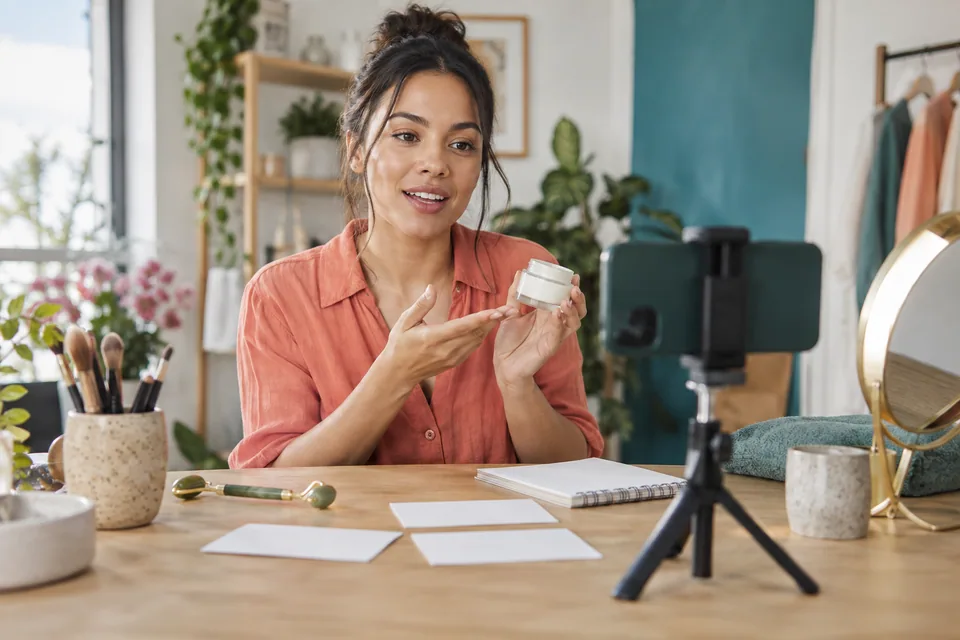
Short-form video is where beauty discovery happens — and UGC-style content outperforms polished ads because it feels like a recommendation, not a pitch. But “authentic” doesn’t mean unstructured. The best-converting clips follow a tight three-part script. Here it is.
You have about three seconds before the thumb scrolls. The hook must name a specific problem or curiosity gap the viewer recognizes instantly: “If your foundation looks cakey by noon, it’s not your skin.” Avoid brand intros and logos — lead with the viewer’s problem, not your product.
This is the demonstration. Show the product’s texture, application or other observable characteristics in real time. Use before-and-after comparisons only where they are truthful, substantiated, representative and permitted for the product category. Do not imply personal use or a guaranteed outcome unless that experience and evidence genuinely exist. Talk through the feature that matters most, using precise, verifiable language.
UGC converts because it shows a real decision being made — not a product being advertised.
End on the visible result and a single, low-friction call to action: “Link’s in my bio.” One CTA, one link. Multiple asks kill conversion.
Because the structure is fixed, it’s suitable for an AI workflow. Feed your engine the product, the reader need or use case, and the standout feature — and have it generate ten hook variations, three demonstration framings and a clean CTA. A human checks every statement against the product evidence and removes unsupported outcomes before publication.
Lock the structure, vary the hook, and you can turn one product into a dozen testable clips — the volume short-form rewards.
This article was reviewed by the PowderedPurple editorial team on 30 July 2026. Read FTC Disclosures 101.
Every guide and product profile on this site passes the same documented checks: verified sourcing with a date, cleared image rights, claim-level citations, and a scheduled re-review. Where the evidence is thin, we say so.
Read our review methodology
Seven repeatable angles for building useful, clearly labelled beauty content before any commercial relationship exists.

Map drops, seasons and trends to a pipeline you can keep.